Friday, 16 August 2013

DC Comics: Hope in Digital

Okay, so maybe I was laying it on a bit thick with the doom and gloom the last time DC came up so take this as the other side of the coin: from what I've sampled their Digital First comics are great.

For those who don't know, spread across the week DC published digital exclusive titles: Adventures of Superman on Monday; Injustice: Gods Among Us on Tuesday; Batman '66 on Wednesday; Legends Of The Dark Knight on Thursday; Smallville Season 11 on Friday; Batman Beyond and Justice League Beyond on Saturday; and Batman: Li'l Gotham every other Sunday.

Of these I read four: Legends of the Dark Knight, Batman Beyond, Justice League Beyond (and previously Superman Beyond) and Batman: Li'l Gotham. So, yes, very Batman-centric but in those four titles I feel I get more variety than in any other four titles I buy from DC.

It helps that Legends of the Dark Knight is an anthology series with a different creative team on every arc so a little variety is guaranteed. True, the early issues were unnaturally obsessed with doing Joker stories but that kink has largely been worked through.

Batman Beyond is a worthy successor to the old cartoon and has just been relaunched as Batman Beyond 2.0, moving time on so future Batman Terry is now in college and Dick Grayson is now his operator. Its sister title Justice League Beyond switches between traditional Justice League large scale threats to he world (but in a more fun way than any of the print Justice League titles) and doing origin stories for the Beyond heroes. We're getting a Batman Beyond Universe spin-off soon and I'm hoping the “Beyond” Flash gets some focus stories (she has Jay, Barry, Wally and Bart living in her head giving her advice).

Finally, Batman: Li'l Gotham is pure fun. Each issue takes a different calendar event (Mother's Day, Christmas, Thanksgiving, Comicon) and tells a fun and frothy little story using chibi versions of the pre-Flashpoint Batman cast. This act of complete insanity is perhaps my favourite thing DC is publishing at the moment.

It's all a lot more varied and fun than the New 52 which is why I'm dropping their print comics at a rate of knots. Justice League: dropped. Goodbye, Action Comics. Farewell, Superman. Teen Titans and Supergirl are skating on thin ice as well, come to think of it. Legion Of Super-Heroes was good but that's being cancelled anyway. Pretty soon I'll be down to Wonder Woman and the Batman books.

Thursday, 15 August 2013

Season 21 Marathon (2) The Awakening

written by Eric Pringle
directed by Michael Owen Morris

Continuity Announcement
Two episodes originally broadcast on BBC One on the 19th and 20th January 1984 featuring Peter Davison as the Doctor, Janet Fielding as Tegan and Mark Strickson as Turlough. Aside from that the story has no continuity with Doctor Who's past or future except for a passing reference to the Terileptils and their tinclavic mines on Raga from The Visitation (1982).

Boxing Clever
Doctor Who DVD box sets are an exercise in compensation. This was released in the almost theme-free box set Earth Story alongside the Gunfighters, the logic going something like this: neither story is a classic, one of them has a particularly poor reputation (The Gunfighters, undeservingly) so slap them together on some pretext and release them together, offering fans a nice discount on the pair. Earth Story is an extreme example but most of the themed box sets work like this.

Thoroughly Modern Who
I watched this DVD one evening straight after the new series episode The Bells Of Saint John and it struck me that, adjusting for the production values of the era, this story would sit pretty well in modern Doctor Who. The most obvious point of comparison is that an old two-parter, minus the credits and titles in the middle, runs to roughly 45 minutes. The comparisons to New Who goes rather deeper than that.

For a start the explanation behind the supernatural Malus is that it's an alien probe that crashed in the village in the 1640s whose purpose was to psychically stir up violence to soften up the population for invasion. The consequence of this was that the village was levelled in the Civil War and the probe somehow damaged so it stopped functioning until Sir George Hutchinson decides to re-enact the battle in 1984. For those playing along at home this is the stereotype Steven Moffat plot of “alien computer pursues its original programming causing dire unintended consequences”.

Our entry point into the story is that Tegan's grandfather lives in the village of Little Hodcombe and she wants to visit. This is, of course, an utterly typical plot device nowadays with whole episodes having been written about Rose's mum, Rory's dad and Martha's whole family amongst others. True, Andrew Verney's disappearance is a minor plot element in the story and is used pretty much just to provide an info-dump at the beginning of the second episode but by classic series standards this gives unusual depth to the life of a companion.

The emotional through-line of the story comes not from Tegan and her grandfather but from a supporting character: Colonel Ben Wolsey. Wolsey is basically a henchman for Sir George Hutchinson. He's played as a reasonable man in counterpoint to Sir George's increasing mania but, crucially, he continues to go along with the games. He voices muted protests now and again in the first episode but takes no action until Sir George orders Tegan burnt at the stake as Queen Of The May.

In the second episode he changes: admits his misgivings, joins the Doctor's side, frees Tegan and in the end takes responsibility for his complicity in the games and confronts Sir George. Crucially, it is this confrontation that puts Sir George in a position to be defeated. Again, we're looking at unusual levels of emotional content here, especially for a supporting character.

The final point of comparison is that there are continuity errors you don't notice because the story moves so fast as Turlough and Jane both comment on conversations they couldn't possibly have overheard (see also the disappearing pirate in The Curse Of The Black Spot).

Who on Earth is Vislor Turlough?
Okay, so next to all this praise for the writing I should mention the one point where the script (and script editing) falls down: Turlough. This is Turlough's seventh story and the first one to be set on contemporary Earth since his introduction in Mawdryn Undead. Turlough is an alien exiled to Earth from an unknown planet for unknown reasons and reacts not at all to being back on the world of his imprisonment, let alone that the agent who used to keep an eye on him might find him. In fact, in the final scene he joins in the chorus of wanting to stay in Little Hodcombe for a while.

It's a small failing in an otherwise very good script, speaking of which...

A Lady of a Certain Age (and a Young Man from Another One)
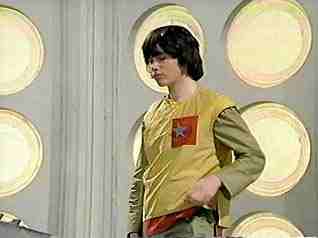
Mention should be made of two other supporting characters: Jane Hampden and Will Chandler. Jane is the local school teacher and Peter Davison's effective companion for much of the story. She's played as a sceptic in the first episode: she's the only opposition we see to Sir George's war games and she disbelieves the Doctor until she's confronted by the appearance of the Malus. Just as with Todd in Kinda we see how well Peter Davison plays off a more mature female character better than he does with the younger women usually playing his companions. There's an absolutely wonderful scene where the Doctor reaches for the TARDIS door control and Jane casually beats him to it with a smug smile.

The other character is less successful: Will Chander, a man transported forward in time by the Malus from 1643 (not quite sure why, I'll be honest). He's there for info-dump purposes and to resolve the Sir George plot but he and the Doctor have some scenes together. The character was apparently considered as a companion, which might have been interesting if not for the awful Mummerset accent the character is lumbered with as a concession to being from the past, one of the odder BBC tropes. There is also gurning, which is even less fortunate.

They are both well-realised characters who seem to have life beyond their plot functions. There isn't much room to explore that life but you do get a sense of it

Malus Aforethought
Okay, so the Malus itself is pretty poorly realised. It is very static: apart from moving forwards slowly it can only move its lower lip up and down and its eyes from side to side. In the final episode it seemingly kills a man by blowing smoke onto him when the man falls down in front of it. It has a second manifestation as an emaciated looking rubber prop stuck to the wall of the TARDIS whose sole point of articulation is its neck and that dies oozing green fluid but otherwise not moving.

Last time I went to town on the Myrka as a crap effect that acted as the living embodiment of everything that was wrong with the production. The Awakening, by contrast, is a pretty good production so it just about pulls off the trick of having the Malus in it and still being good.

It isn't possible for the script to make the Malus a good effect but it does make it salvageable and that's an important distinction. Special effects date so whether they were good or not on first transmission they'll always need to be saved by the other production values in the end.

Next Episode
The TARDIS faces the only enemy that could possibly destroy it: woodlice from SPAAAAACE!

Wednesday, 14 August 2013

WTF JNT? or, season structure in '80s Dr Who


Apparently he tried to watch Arc Of Infinity in one sitting

You know, I didn't want to get into the hoary old fan debate of “what exactly John Nathan-Turner did wrong” this soon. I mean, if I see this project through to the end I'll have another eight seasons of his to sit through and Season 21 isn't even the worst. There's also the fact that the debate has been gone over so many times and there are so many incompatible first-hand accounts of what actually happened that it seems kind of pointless to dive into it at this late stage.

Season 21, however, is too good an example of one problem to let it pass without comment. You see, the structure of the season is absolute crap.

We dealt with the season opener, Warriors Of The Deep, in depth last Friday but the quick version is this: it brings back monsters no one would remember, forgets what made them interesting to start with and had to be made with a massive cut in production time due to a general election. The middle of the season features three stories in which at least one main cast member enters or leaves and then is capped off by the infamously cheap and abysmal The Twin Dilemma that rebrands the Doctor as a physically abusive, selfish coward.

Structure is not the strong point of JNT's years in charge. It should be said in his defence that his first season had a good opener and finale but since it began with a bold new look and ended in Tom Baker's regeneration I don't know how much we can credit the production team with actually thinking about it so much as circumstances conspiring to make those stories memorable. Even in Season 18, though, we have the E-Space Trilogy whose middle story was an unused script from the Hinchcliffe/Holmes era that had sod all to do with the overarching theme.

Season finales seem to be the worst affected with duds like Time-Flight and The Ultimate Foe, low-key fare like The King's Demons and even Revelation Of The Daleks which looks like an event story on spec but gives the Doctor and Peri practically nothing to do and resolves almost without their involvement in the main plot.

Now, I know we can't expect 1980s television to conform to modern expectations. I can't go into these stories expecting a long season arc, not even in the seasons that claim to have one. The Key To Time, for instance, is more of a background theme than the driving force behind most stories in Season 16. What I can expect, though, is for the producer to know that a season opener should be a belter to grab audience attention and the finale should be an exciting story so they remember to tune in next year.

I can expect this because I know Doctor Who managed this in the 1970s. The '60s were a different beast: the show was on for forty-plus weeks a year and produced with almost zero lead time so seasons didn't really exist, it was a continuous serial. The Jon Pertwee and Tom Baker years, however, cracked it.

Pertwee's five seasons have an attention-grabbing opener (New Doctor! New arch-nemesis! Daleks! Three Doctors! New companion!) and close with suitably epic confrontations (Doctor versus fascist UNIT! The Master summons the Devil! The Master versus the Doctor for the fate of Atlantis! Jo leaves! Pertwee leaves!). The Tom Baker seasons make the epic nature of the finale structural by having them be the only six-parters in five out of Baker's seven seasons (today we are counting Shada). His openers don't have the one-line summary punch of Pertwee's but they were usually written by some of the top talent the show had and were consistently well-produced.

Yet somehow in the 1980s supposedly fan-pleasing but general audience-alienating stories like Arc Of Infinity and Warriors Of The Deep seemed like the sort of thing the season should open with. In hindsight, if I had to choose any story to open Season 21 it would be Frontios. Now, I'll have some criticisms of Frontios when I get to it but nothing as dire or systemic as Warriors Of The Deep. It even has a fantastic shock moment when the TARDIS is seemingly destroyed.

But no: twelve years absent monsters and a depressing ending. Still, as I say there are some good stories in the middle.

Tuesday, 13 August 2013

Dear DC, as a male aged 18 to 35...

[This is written in response to a post by SallyP of Green Lantern Butts Forever on the current creative state of DC Comics. Go and read her post then go read some others because it's genuinely one of the most fun and friendly comics blogs going.]

One of the problems with DC's current creative approach is the statement, which I find boneheaded even two years later, that the New 52 initiative was aimed at “males age eighteen to thirty-five”. This statement raises two questions:

Question 1: What do they think this demographic wants to read?
Question 2: Why do they want this demographic?
Question 3: Why don't they want to pursue other demographics?

To begin with Question 1 and acknowledge Sally's post directly: what DC thinks my demographic wants is Batman. This is not entirely wrongheaded. The Batman franchise is probably the company's most profitable product: the Batman group has more core titles and spin-offs than any other group DC publishes and it has spawned more films and TV series than any other DC property. I'm not going to argue with this fact as I rather like the Batman books.

Unfortunately this has led to the rather unfortunate idea that what people like me want is the Batman approach applied to every DC property: dark, brooding, morally ambiguous and violent. This has been justified in terms of creating a cohesive universe.

What it actually creates is a dire lack of variety. The approach works in some cases such as Batman and Animal Man but applied to the likes of Teen Titans or Blue Beetle it robs those books of their original selling points (fun, in the case of those two examples).

So, Question 2: Why do they want this demographic? Men aged 18 to 35 are the old “Cult TV” demographic beloved of such shows as the X-Files and Sliders. The point of this demographic was that it could support a programme that didn't get good ratings on transmission (and therefore didn't generate advertising revenue) because they had copious disposable income to spend on merchandising.

The problem with this approach is that the cult TV market died a death years ago after producers, starting with Joss Whedon, discovered there were other audiences out there with money to spend. Sci-fi and fantasy television these days is either explicitly aimed at the mainstream (Doctor Who) or created as a premium product (Game Of Thrones) that starts with the old cult audience and draws in other viewers through sheer quality.

In either approach we see that TV has got over its tunnel vision to bring sci-fi to the masses.

As Sally quite rightly points out, what DC are basically modelling themselves on is Marvel in the '90s. Marvel in the '90s almost went bankrupt (in fact, I think they briefly were before being bought out) and the era is rightly remembered as being a creative wasteland of repetitive stories that went nowhere.

Which brings us to Question 3 and my complete lack of an answer to it because the idea that any entertainment company doesn't want to expand its audience is completely beyond me. Males age eighteen to thirty-five have been the traditional audience for comics since they became too complex and interlinked to be adequately followed on pocket money (18 – 35 can be most easily defined as “old enough to earn a wage, young enough not to have to spend it on a mortgage”).

Female fandom is a real, vocal demographic that has had measurable impact on the world of comics, most obviously in being the background many modern female creators came out of so making a point of alienating them just costs you money. Frankly, given how comics companies routinely piss women off female fandom is a target rich environment and if you bring them a great series that respects them as an audience you can get real loyalty out of them.

Targeting the under-18s is a good way of a) creating a future audience and b) getting money out of parents who would normally not shell out for your product. And, finally, the over-35s are more likely to be super-loyal because they've been following your series for years (the “gateway drug” phase of comics being more likely to be in your teens than your twenties or thirties) and whilst they don't have the disposable income of the 18-35 bracket they do have some money.

In the end DC's approach does acknowledge that their product is a commercial one but they actively seem to have given up on bringing new money into their business. It's utterly bizarre.

Monday, 12 August 2013

At last, an interesting Space Marine rumour

It seems the Sternguard and Vanguard Veterans are being remade in plastic for this edition. Unfortunately, GW haven't leaked pics onto the internet yet.

(As an aside, yes I do think these leaks are made by GW itself otherwise the pictures would be of far better quality. The usual story is that some random hobbyist in, say, Poland, got their copy a week or so in advance. It doesn't half seem odd that, a: this happens every month and, b: it never happens to someone with a decent scanner)

I have high hopes for the kit. Yes, I found the Centurions absolutely dire but it is significantly easier to muck up a new concept than it is to muck up a Space Marine, one of the most defined images in the game. So this rumour has inspired me to purchase...

… a box of the old Finecast Sternguard Veterans before they sell out. This is for the plain and simple reason that the Sternguard Sergeant is one of my favourite models ever. He's the fellow bottom left with the power fist and Errant-pattern armour, a vision of sheer, uncompromising brutality.

Now I just have to hope GW still has some in stock when they re-open on Wednesday and that I can decide what chapter to paint them as (currently havering between Novamarines, Exorcists and Flesh Tearers). The plastics I will probably purchase in due course for my Deathwatch modelling project (it's far too fast-and-loose to call it an army).

Sunday, 11 August 2013

The Comics Ramble Goes Soap Opera

I've always liked a dose of soap opera in my comics. Most likely this is because I got into comics through the 1990's X-Men cartoon and black-and-white collections of the Chris Claremont run. I just bring this up because soap opera dynamics seem to be something of a theme in the comics I bought this week, the Marvel ones at least.

All-New X-Men #15
I don't hate Cyclops but I have to admit the character has rarely interested me. All too often he has this “perfect soldier” character to him that I can't get into at all. Even the teenage version of the character, both here and in the Sixcties comics, has this problem. In this issue, however, Bendis has him do something that made me absolutely love the character:

He and Bobby Drake use their powers to stop a car thief the police are pursuing at high speed. They do it casually, with affected nonchalance, as if this is a doddle and somehow beneath them. They don't do it because of high-minded morals or in accordance with Xavier's dream but because they want to impress some girls they've only just met.

Actually all the scenes with the random girls (who I hope turn up later) absolutely shine, especially when Scott hears one of the girls say she wishes she was a mutant. This absolutely bemuses Cyclops:

“... we're just so used to people hating us […] that it's - - it's just odd that anybody would romanticize our situation.”

And then I started to understand Scott because suddenly his personality related to something real I could understand. This Scott comes from a time when there was no public mutant culture, no visibility for people like him and because his mutation is outwardly and explicitly dangerous he's had more reason than most hide what he is. Scott is, in an allegorical sense, a homosexual who has just moved from a place where he was totally closeted and even vaguely ashamed of who he was to somewhere he can “come out” in relative safety. He can now be publicly associated with being a mutant and, whilst one guy does a runner in fear, he can even use it to impress cute people.

Yet in spite of all this the best scene of the issue is Jean Grey meeting her future daughter Rachel for the first time. This has to be a heavily-anticipated meeting, I admit I've been looking forward to it for a while. Bendis, genius tease that he is, reduces it to a perfectly executed sight gag where neither woman can figure out how to handle this incredibly bizarre situation.

Dial H #15
Was this the end? I don't remember the series being announced as ending but it seems a pretty conclusive close to the story.

Regardless of whether this is the end or just the “season finale” this was a grand tying up of threads (wires?) from the rest of the series. We got the origin of the dials, a glimpse of the world of the Exchange and even the identity of O. The Exchange is an absolutely perfect Meiville creation, well up there with Railsea or the inter-dimensional weirdness of The City & The City.

Unfortunately it was so good I can't bear risking the spoilers that doing an It's The End, But... post would entail.

I just hope that someday we see Open Window Man in a comic of his own.

And talking of series I'm going to miss...

X-Factor #260
Only two issues to go! Aw.... but Peter David is certainly leaving on a high. I like that he isn't just giving the characters inconclusive endings, which I admit was about the only thing I didn't like about Dial H #15. My favourite conclusion so far was having Rahne join the church as trainee deacon.

This issue was Polaris getting drunk and then having a punch-up with her half-brother Pietro, former semi-regular X-Factor pseudo-villain. It was worth it just for scenes of Polaris drunkenly explaining the crap she's been through since joining X-Factor to a bemused and slightly frightened bartender. The superhero fight with Quicksilver was just icing on the plate.

The end did leave me curious as Polaris was offered a place with another X-Factor. Peter David is going to be a hard act to follow but I'll give a chance so see if I like it. Upon which subject:

Superior Spider-Man #15
I cannot, for the life of me, work out whether I like this series or not.

On the one hand I love the innovation: Peter Parker's body possessed by the mind of Doctor Octopus is absolutely brilliant. I especially like Anna Maria, Doc Ock's study buddy and potential girlfriend, who makes a wonderful addition to the sprawling Spider-Man supporting cast.

I also like that people are starting to catch on that something is up, not least of them Peter's ex (and CSI) Carlie Cooper. This unfortunately brings us to the part of the story I am not enjoying: the way Doc Ock's arrogance plays off the supporting cast. Whilst I can see that the angle is firmly on Ock frittering away his second chance at life the cringe comedy of his interactions with others (most especially the Horizon Labs cast) grates on my nerves.

I know, as everyone knows, that Peter will be back someday but I also know that this isn't in the immediate future or Slott wouldn't have killed off the “ghost” of Peter haunting Ock. Much like the series as a whole I don't know how I feel about this: the series is interesting but there are significant aspects of the writing that I don't like.

To drop or not to drop? That is the question.

Friday, 9 August 2013

New Space Marines: Meh and OH GOD WHAT I DON'T EVEN!?

In spite of what this post might lead you to believe, I am not usually in he habit of moaning about Games Workshop. Usually I quite like what they bring out and when I don't I'm not too fussed. Every once in a while there's a facepalm moment that just has to addressed and this is one of them.

You see, this post started life as just me picking up on some Space Marine rumours and realising how spectacularly unfussed I was about the whole thing.

After all, we know how this goes: Space Marines are so well-established and so well-explored that each new Codex amounts to the same basic structure with a couple of new entries that take an aspect of an existing unit and make it a speciality (Sternguard and Vanguard Veterans, Ironclad Dreadnoughts) and maybe a new weapons load out on one of the tanks (probably a Land Raider), add a few new special character and off you go, bish bash bosh. Simple release, come back next month for something inventive.

Aside from that was the strong rumour that Black Templars were being folded back into the basic Codex, which struck me as pretty sensible pretty much for the above reasons. There's not much more to explore with the Black Templars, who amount to Codex Marines with a single unique Troops choice and a lot less stuff overall. It all boils down to the fact that there's really not much GW can plausibly release for them in the future. They are a concept that is out of ideas.

Not that the Templars are seemingly alone in this, as these abominations recently surfaced on the interwebs:

Okay, I can sort of see what they're going for: a halfway point between Terminator and Dreadnought or maybe a Space Marine equivalent of the Imperial Guard Sentinel. The problem is that they look absolutely bloody awful. The unit comes in two variants of which this picture is of the combat version, there's also a “Devastator” version which one rumour says “will have more guns on them than any single model we've ever seen before”.

And this just makes me shake my head in resignation. Yes, it is obviously only a rumour but it points to a psychology that I think is doing active harm to the 40k side of this hobby. I try not to judge by the vocal minority but in this case the vocal minority does seem to be having an effect on what gets released. The minority in question being power gamers who will buy the biggest, most powerful thing regardless of price or aesthetic worth just so long as it wins them games. Whilst I don't want to rob anyone of their fun (and these are people who do seem to get real pleasure out of discussing statistics and pounding fellow power gamers into the ground) but it does seem to me to be part of a vicious cycle:

The fact that these models sell on the strength of their rules rather than their appearance means we get things like these Transformers cosplay nightmares or the Khorne Lord Of Skulls that are not quite in keeping with the design cues of the army and covered in smooth planes where detail should be. GW can afford to be a little lazy in design and sculpting because they can be guaranteed of sales. I can't even say I blame them for this tactic, they're a business an it's perfectly understandable that if they can save some time and money they'll do it.

The thing is, less powerful units that have come out recently just throw this attitude into sharp relief. The Deathwing Terminators and Ravenwing Knights were wonderful sculpts covered in detail, the Dark Vengeance starter set was spectacular and the plastic Eldar Farseer was brilliant. Foot troops and starter sets aren't designed for the power gamer, though, but a more general audience whilst the big centrepieces find their audience in the deep pockets and competitive instincts of power gamers.

Lest it seems I'm being too hard on power gamers and mono-40k players (neither of which I am) I feel the need to really put the boot in and point out that I think I'm the one reaping the benefits. If I'm right and models like these and the Lord Of Skulls are jobs where the designers get to knock off a bit early then where is the money from their sales being invested?

Fantasy. Which I play almost exclusively. So thank you, 40k power gamers, for buying these inferior models and bankrolling the Tomb Kings Necrosphinx, Lizardmen Carnosaur, High Elf Phoenix and Empire Griffon, most generous of you.

Thank you, Mary, and good night.

Season 21 Marathon (1) Warriors of the Deep

written by Johnny Byrne
directed by Pennant Roberts

Continuity Announcement
Four episodes originally broadcast on BBC One from 5th - 13th January 1984 featuring Peter Davison as the Doctor, Janet Fielding as Tegan and Mark Strickson as Turlough. The story is a sequel to Doctor Who And The Silurians (1970) and The Sea Devils (1972).

Then And Now
It's not a new observation that we don't watch these stories the way they were originally intended. Whole fan projects have been based on this observation: TARDIS Eruditorum and Running Through Corridors being the cream of the crop. This story was originally shown over the course of a fortnight and was a sequel to two stories much of the audience would not have seen, which weren't commercially available and so the producers could readily assume no one would accurately remember them.

This DVD, which I watched straight through in a quiet afternoon, was sold in a box set with the two 70s' stories.

So there are two versions of Warriors Of The Deep: the 1984 version that stood on its own supported in some cases by fuzzy memories and the 2013 version where I know every detail that came before in digitally remastered clarity. Even Johnny Byrne didn't have that luxury: he was provided with markedly inferior copies of the two Pertwee stories that he found exceptionally hard to follow.

So, which version is better?

The Bête Vert
Whatever version we eventually settle on the Myrka is not going to come out smelling of roses. The Myrka isn't just a bad special effect, it's a famously bad special effect and as such exerts a gravity on all criticism of the serial. A cut in pre-production time (due to the surprise 1983 General Election) meant it was made in a rush, famously the green paint rubs off on several other actors.

And it is bad, there's no denying it. It is wobbly, it has googly eyes, it sways dizzily from side to side as it walks, it has humanoid arms for no discernible reason and there is an absolutely hilarious scene of Ingrid Pitt fighting it karate style where the cumbersome costume stops the Myrka from reacting to her at all.

In short the Myrka is rushed, poorly designed and a staggering misjudgement of what the series could do with the time and budget available. In many ways there couldn't be a better metaphor for Warriors Of The Deep as a whole.

Just Like Old Times (Only Different)
There can be no mistaking that this story was made for fans: who else could be expected to appreciate a sequel to two stories from over a decade ago? The continuity at least we can assume worked better then: without a DVD to hand probably no one would spot that Ichtar wasn't a character in The Silurians or that there was no Myrka in The Sea Devils and so wouldn't ask how the Doctor recognises both. This is the 1984 version of the story.

Here in 2013 I have shiny DVDs of both original stories. I know full bloody well that Ichtar doesn't appear in The Silurians and nor did “the Silurian Triad” of which he is apparently the last survivor. This is not a problem, I'd like to make that clear. This is how monsters come back now: the central concept is dusted off and retooled with new ideas grafted on. Sontarans might gain football chants but they still have the potato head design and clone warrior background, in short all the iconic cues everyone remembers spruced up with modern technology.

The problem with this resurrection is that the iconic elements of the concept is almost invisible. Malcolm Hulke's two stories positioned these creatures as the aboriginal inhabitants of the Earth. They were sympathetic, written as individuals (more so in The Silurians than The Sea Devils) and with a genuine prior claim to the planet and forced to drastic action by human xenopobia. Half the drama of both stories comes from the Doctor having a genuine chance at negotiating peace before an outside influence (the Brigadier in one, the Master in the other) scuppers his chances and a bloodbath ensues.

The Silurians in this story are plotting genocide, will not listen to any of the Doctor's peacenik claptrap and the Sea Devils are portrayed as identical soldier drones like any other monstrous minions.

So this story doesn't work as a sequel but does it stand on its own?

Doctor Who and the Massacre
The whole structure of the story is a base under siege plot building towards a big set piece ending: the Doctor standing over the bodies of everyone (human and reptile) that he has met over the last 100 minutes and saying “There should have been another way.”.

The problem with this is, despite the Doctor continually talking about the honourable and advanced society of the Silurians, they don't want peace. This honourable and advanced society has apparently outlawed all war except in self-defence, which one would assume would prohibit genocide. Their way around this is to take over a human undersea base which has a bunch of nuclear missiles pointed at the unnamed enemy in a future cold war. They are going to fire the missiles, trigger the nuclear holocaust and then sit back to rule the Earth after all the pesky “ape primitives” have killed one another.

Why would anyone try to make peace with these peoples? The ending makes no thematic sense because at no point was an alternative seriously possible.

All that said the base that is under siege has some good stuff going on inside it. It's 2084, there's another Cold War (or the same one, they weren't too optimistic on this issue in the early Eighties). There are secret military bases under the ocean, of which this is one, and the crew live in constant tension because of a series of random unannounced drills to make sure they really will push the button when it comes down to it. Even better the final failsafe on this system is the “synch operator”: a human being mentally linked to the targetting computer without whom the missiles cannot be fired.

On this base there is a conspiracy going on: two enemy agents embedded as the base's first officer and doctor (the latter played with a wonderfully over the top accent by Ingrid Pitt) have killed the synch operator and now the post is being covered by an inexperienced and psychologically unstable student. They fully intend for this poor young man to have a breakdown from the stress so they can move in and use the technology in his head to reprogramme him and use him to take out the base.

The base has a pretty good crew: well-cast, well-realised characters. There's some odd dialogue, not least in the self-consciously apolitical decision not to name either of the parties in this war, but by and large the base scenes work very well. Unfortunately this isn't what the story is about. The base and the conspiracy are window dressing. Notably the conspiracy goes nowhere and the conspirators are amongst the first casualties in the early stages of the climatic slaughter.

What the story is about, what the series will increasingly be about over the next two seasons, is the return of old monsters to please the fans and not about creating a dramatic setting and exploring it. A compelling story could be made from the base personnel and their world, a statement I'm confident in making because for much of the first two episodes that is exactly what happens.

In conclusion, neither version of the serial is entirely satisfying on its own merits and the serial I like is the one that gets walloped over the head late in the second episode when the Silurians fully intrude on the plot.

Next Episode
A bijou adventurette in which Lovecraftian weirdness brings the English Civil War to rural England in 1984.

Thursday, 8 August 2013

Tomb it may concern (Tomb Kings army list)

Now I've started making definite progress on the Tomb Kings I thought it was about time I put together an army list. The battalion I'm working on will form the core of the force, as to the rest I already have some random character models to paint and the rest of the army will comprise whatever else I think looks pretty (yep, that sort of hobbyist).

Lords
King Amanhotep the Intolerant Tomb King armed with great weapon and wearing the Armour of Silvered Steel. Army General. 221 points

Heroes
Liche Priest, Level 2 Wizard riding a Skeletal Steed. Army Hierophant using the Lore of Nehelhara. 115 points
Liche Priest, Level 1 Wizard using the Lore of Nehekhara. 70 points
Liche Priest, Level 1 Wizard using the Lore of Death. 70 points
Tomb Herald armed with hand weapon, wearing light armour and riding a Skeletal Steed. Battle Standard Bearer carrying the Razor Standard. 140 points

Core
30 Skeleton Warriors armed with spears and shields and wearing light armour with full command. 210 points
10 Skeleton Horsemen armed with hand weapons, spears and shields and wearing light armour with full command. 160 points
5 Skeleton Horse Archers armed with hand weapons and bows with Master of Scouts. 80 points
3 Skeleton Chariots armed with spears and bows with full command. 195 points

Special
20 Tomb Guard armed with halberds and shields and wearing light armour including full command. 290 points
3 Sepulchral Stalkers armed with halberds. 165 points
3 Ushabti armed with hand weapons and great weapons with Ushabti Ancient. 160 points
Tomb Scorpion. 85 points

Rare
Necrosphinx. 225 points

Total: 2396 points

If there's one guiding principle I can take from my Vampire Counts it's that Undead can never have too many wizards. Three wizards with four spells between them should be enough and I'll use the third to experiment with some of the other Lores available to the army.

One of my bedrock principles is to have lots of core choices (of which this list has five) and plenty of infantry, especially if the infantry is fragile like Skeleton Warriors. Two large blocks of thirty,in five ranks of six fits the bill nicely alongside a nice twenty-man Tomb Guard unit for Amanhotep to hide in.

The thing I like most about the army are the Animated Constructs so I've gone for a spread of my favourites: Tomb Scorpion, Sepulchral Stalkers, Ushabti and a Necrosphinx stomping to war alongside the massed infantry and cavalry.

On that subject I have gone for a cavalry-heavy core. I'm not sure how a cavalry force that can't match will work out but I can always swap out for something else if it doesn't work (of expand into an all-cavalry force if it does).

Wednesday, 7 August 2013

Oh yes, that Doctor Who marathon thing...

Old Sixie handles the disappointment manfully.
Yes, I was going to marathon the Colin Baker era but two things occurred to me about halfway through The Twin Dilemma Part Two.

Thing 1: I only recently got over a period of harrowing bleakness and loss of faith in the world in general and the human race in particular. Watching 31 straight episodes of one of my absolute favourite things in the world violently imploding might not be the best thing to do at this moment.

Thing 2: The Twin Dilemma is a stupid place to start in any case. Its one of the series' most tragically misjudged moments but it didn't happen in isolation. Hard as it is to believe from watching it the story was a season finale. When I talk about the new series it tends to be in reference to seasons because they're a body of work. So if I want to understand The Twin Dilemma in all its awfulness (or even, Heaven forbid, to come to an appreciation of it) I really should start at the beginning of Season 21, not the end.

I'll readily admit that starting with Warriors Of The Deep may not be much of an improvement in the “maintaining faith in humanity” stakes but at least I can laugh at the Myrka and there are genuinely good stories to look forward to between the two (Caves and Frontios, I'm looking at you).

So, next episode: A pantomime brontosaurus, Ingrid Pitt doing ill-advised kung fu and a secret military base staffed entirely by New Romantics.

Tuesday, 6 August 2013

It's The End, But... Batman Incorporated v.2

It seems odd to say this of the last hold over from the pre-Flashpoint DCU but it really was the perfect example of what a New 52 series should be.

Okay... back up... explain the assertion, James. To put it simply: compared to the rest of the New 52 this series was off in fairyland half the time. Try to reconcile half the characters in this with the rest of the present DCU and this is thrown into stark relief: Jason Todd as Wingman has nothing to do with events in Red Hood And The Outlaws; Red Robin is so much closer to the Bat-family than Teen Titans suggests; Batwing is from “Mtamba” not the Congo; and the Outsiders don't seem to exist at all outside this series.

And I couldn't care less. This series told a tight, self-contained and thoroughly entertaining story. Despite using a lot of iconography from Morrison's previous work on the franchise (Talia's Man-Bat Commandos; the apocalyptic future where Damian is Batman) and obscure relics from the past (the Kathy Kane Batwoman) it really didn't rely on continuity all that much. A doubly impressive feat since the series was consciously and explicitly the pay-off to all of Morrison's Batman series.

In effect this series was Grant Morrison writing the All-Star series Batman deserved instead of the insane trainwreck Frank Miller half-produced.

The series had some very cool nods to the past. My personal favourite was resurrecting Bruce Wayne's down-at-heel gangster alter ego Matches Malone. They were nods, though, and this wasn't a story about that past, as much nostalgia as Morrison clearly has for it. History here is a menu to choose from rather than a strict order of published events not to be contradicted.

It helps that this was probably the most linear and accessible series I've seen from Morrison since, well... All-Star Superman, I should think. Action Comics, Final Crisis and even the end of the first Batman, Inc. series all played around with complex and sometimes unreliable narrative structures. This was, beginning to end, the story of Batman having the final confrontation with Talia al Ghul that had been building since Morrison entered the scene with Batman And Son. It was a refreshing change of pace.

Given all this, it was right and proper that Morrison got to kill off Damian. Characters don't belong to people in work-for-hire comics but when he died it did feel like this was the pay-off to Damian's introduction and that all those other stories other writers told in the interim served their purpose in making us care all the more when the poor, ill-treated boy finally snuffed it.

Monday, 5 August 2013

The 12th Doctor revealed...

… and he's British, white and male. Scots, in point of fact. Ho hum, better luck next time or maybe the time after that (anyone who seriously believes the BBC will allow a throwaway line written in 1976 to cancel one of their most popular series can go sit in the corner and play with their crayons).

Anyway, Peter Capaldi. I have to admit I haven't watched The Thick Of It but friends I usually trust about these things tell me it was good. I did go into HMV this afternoon looking for a copy but, in the words of the charming young woman on the checkout, “Some other Doctor Who fans got here first, honey.”. What I do have, of course, is his previous Doctor Who appearance: The Fires Of Pompeii.

(As an aside, I think The Fires Of Pompeii now has the highest density of future Doctor Who regulars playing other parts. It's got the Twelfth Doctor as a senator, Amy Pond as a prophetess and Klein from the Big Finish audios as Mrs Senator.)

First impressions? Honestly, I was pretty much sold on the idea the moment Capaldi's Senator lauded the TARDIS as “Modern art!”.

Don't get me wrong, I'm going to miss Matt Smith like nobody's business but the future seems bright. I'm looking forward to the traditional set pieces: the wardrobe scene, convincing Clara he's still the same man; first encounter with the Daleks; first speech about the wonders of the universe.

But I'm getting ahead of myself here, dear Mister Smith has a while to go yet and we still have to sort out the whole John Hurt situation before we move on to the Peter Capaldi era.

Sunday, 4 August 2013

The Comics Ramble: Ladies' fashions in Uncanny X-Men #9

Last week's pull was a light one and, really, the only thing I feel like discussing (possibly under the influence of finally reading Chicks Dig Comics) is how the female characters in this issue are dressed. Don't run away! There's some element of plot analysis in this, as well, I swear.

Dazzler: Agent of SHIELD
Let's deal with the elephant in the room first: in my opinion, Dazzler is absolutely rocking the high heels on that costume. High heels are, of course, the single most impractical piece of women's fashion ever invented (though the back-lacing corset comes in a close second) and usually I would be up in arms with everyone else about the bloody things.

Batgirl in heels, for instance, is one I'm dubious of. Batgirl is a leapy-about, ten-against-one, lose your balance and you're dead kind of hero whose costume comes from an otherwise very utilitarian design aesthetic. Anything about her costume that isn't instantly practical (the utility belt, the mask) is designed to make the Batman connection in the minds of criminals (the symbol, the cape).

No one has ever accused Dazzler of being practical about her costume, after all it used to include roller skates. Dazzler is a former pop star, presentation and style are big things in her design aesthetic. She's a SHIELD agent now so naturally she's wearing a shiny catsuit because you know who the most stylish female spy in history was? Emma Peel. Emma Peel's two modes were “catsuit” and “sexy mod fashions” and Dazzler's white PVC and heels sort of split the difference between the two.

Curiously, the heels serve a sort of purpose. The “point” (he said sarcastically) of high heels is to stretch the leg muscles to give them extra definition. Heels on this costume a) make Dazzler taller, significantly taller than anyone in the Medina household and, b) allow her to pose a little. In my own personal head canon that cover is Dazzler standing in front of her bedroom mirror trying on the idea of “I'm a super spy now” for size.

Because this is a real step up. Dazzler's last series (the short-lived X-Treme X-Men) thrust her into a leadership role and that clearly hasn't been forgotten. Her confrontation with Cyclops in this issue is clearly of the earnest, passive-aggressive pissing competition variety when two strong alpha personalities collide. She can't quite hold the pose until the end, though, and is reduced to a petty comeback as Cyclops swans out so she's not quite there yet but she's gained considerable confidence just to hold his stare and turn him down.

Irma Cuckoo
There's a training scene with Cyclops' new X-Men where Irma Cuckoo swans in late wearing her Grey School uniform and, quite scandalously to her sisters, she has cut her hair and died it black. The Cuckoos have always been completely identical, even homogeneous, and the last time one of them displayed individuality they tried to murder Emma Frost and joined the Brotherhood.

It should also be noted that what the other Cuckoos are wearing are X-Men uniforms from the Grant Morrison era. I don't have an extended analysis of this to make, I just loved the uniforms from the Morrison run and I'm glad to see them back. Though it is interesting that when the team goes into combat against SHIELD Eva dumps her uniform and goes back to the sleeveless top and miniskirt civvies combo she's been wearing since the series began, which is probably more “her costume” in most people's head by now than any X-uniform (the miniskirt and lack of sleeves give it a distinct silhouette even if she does appear to have no bum).

Emma Frost
This one, obviously, is not a development of issue 9 but since the new series began Emma has dropped her usual revealing white outfits for a no less revealing black one.

One of the big plots Bendis is working with is that the former-Phoenix-possessed X-Men are having trouble with their powers. In a previous issue the Cuckoos invaded Emma's mind to prove a point and discovered this fact, which Emma described as them trying to hurt and embarrass her and admitting they did. Without her powers (her psychic ones, at least) she no longer considers herself the White Queen and so no white costume. But it goes deeper than that: whilst the black costume might be as revealing as some of her previous wardrobe choices with a cleavage-revealing cut-out from waist to throat (Power Girl boob window haters, beware) she now wears an ankle-length black coat over it.

Aside from making her look like a bit of a dodgy flasher this shows us how far Emma's self-esteem has fallen. She wears a revealing costume because that's what Emma Frost does but she no longer feels confident in utilising her body as she used to. Her appearance and the effect it has on others has often been allied to her confidence and self-perception (she's the only superhero I can think of who achieved her perfect physique through cosmetic surgery). Her loss of power hasn't changed her appearance in the least, she still has it but she no longer feels the confidence to flaunt it. All of this brings us to the question:

Is Dazzler the new White Queen?
So we have Emma Frost in a crisis of confidence giving up her usual visual iconography: black costume, less revealing. At the same time we have Dazzler turn up with new confidence and leadership skills in a white catsuit with kinky boots and what I assume to be an integral flak jacket but could easily be taken for a corset.

And what is the reaction of Cyclops, Emma's ex-lover, the first time he sees this vision in white and bondage accessories? This tall blonde whose new costume so resembles his ex-girlfriend's old iconography? He offers her a place on the team. Right in front of Emma! That's nerve, that is.

Saturday, 3 August 2013

The long-awaited return of... Adric?

A few days ago Big Finish made a surprise announcement: Matthew Waterhouse will be reprising his role as Adric for a trilogy of adventures next year.

Adric is not the most fondly remembered companion and Waterhouse is not the most fondly remembered performer of the classic series. In fact, that he was a pretty bad actor and that his character was particularly poorly written is hard to dispute. Numerous anecdotes have been told by his fellow actor that paint him in, shall we say, a less than favourable light. Plus he wrote his autobiography in the third person, which is just odd. Taken on spec this wouldn't seem to be a comeback to look forward to.

However, it isn't like Big Finish didn't test the waters first. Waterhouse has already appeared in one of their Dark Shadows plays. I admit I don't follow the Dark Shadows series but it means we know Big Finish have had a taste of Waterhouse's current acting skills before making the decision to cast him in their most high profile series (it has, after all, been 31 years since he was in Doctor Who).

The return of Adric, if done well, would be the ultimate cap to a theme that has been running through the Fifth Doctor plays for a long time: the redemption of the Peter Davison era. There's a lot of wasted potential in those three years and Big Finish have gone to great lengths to exploit that potential.

Most of this is due to how long it took for Janet Fielding to accept the offer of a role. Since she appeared in all but two of Davison's TV stories this meant Big Finish had to get creative, making extensive use of casts that only appeared in one or two stories. So now we have a huge body of stories featuring the Fifth Doctor and Peri (only together in two stories), the Fifth Doctor and Turlough (one story) and the Fifth Doctor and Nyssa (in the gap between Seasons 19 and 20). Even when Fielding finally gave in they proceeded to make three years of stories featuring Tegan with Nyssa and Turlough, a cast that only got two stories as a group.

The list of missed opportunities they've exploited runs deeper than the central cast. The third season of Lost Stories offered us unmade scripts by Barbara Clegg and Christopher Bailey whose TV serials were underrated in their time but viewed as all-time classics now. Marc Platt even dusted off Bailey's creation the Mara for a third outing, giving the theme the closure it didn't have on TV. Platt also wrote Spare Parts, a Cybermen story that achieved the high emotional drama Earthshock tried to reach by killing off the the least popular character in the cast (his name's in the post title). They even produced a sequel to one of Davison's great turkeys, Arc Of Infinity, to give him a confrontation with Omega that was actually about Omega instead of just a guy in bad Omega cosplay.

Even one of the most often-criticised aspects of the era comes in for re-evaluation, the so-called “soap opera” elements. On TV this amounted to constant bickering between the main characters and short references to the last story at the top of every serial's first episode. Big Finish have given us whole plays about the consequences of other stories: The Gathering revisits Tegan twenty years after she left in Resurrection; Three's A Crowd explores Erimem's mental state following The Roof Of The World; and, one of the episodes of Circular Time explores Nyssa's feelings about her father's death and the destruction of her homeworld. This last one is notable because there is actually a story where Nyssa is confronted by the man wearing her father's corpse as a skin suit AND DOESN'T REACT TO THIS AT ALL!

Who knows, perhaps the return (and consequent re-evaluation) of Adric will be the crowning glory of Big Finish's grand redemption of the Peter Davison era.

Friday, 2 August 2013

Fluff on Friday: It is said of Amanhotep...

My Lord Elector Gausser, please find enclosed my final translation of the rubbings taken from the necropolis of Zandri by your late servant Professor Sondergard. I apologise for the delay in their delivery but there were significant flaws in the late professor's initial translations.

Your humble servant,


Doctor Englebert von Wer
University of Altdorf


It is said of Amanhotep that he bore the blood of Zakash in his veins and by that right did rule he Zandri for four and twenty years.

In the fifth year of his reign he made tribute to the Great King Rakaph and restored peace with Khemri. From that day forth did the fleets and legions of Zandri join in the great work of restoring the Kingdom to its former glory.

Amahotep did lead his legions in glorious battle for many years. He fought the savage greenskins who did desecrate the Valley of the Kings. He did march south with the Great King Rakhash and did aid in the conquest of the lands of Mahrak, Lybaras and Lahmia.

In his time Amanhotep did beget eight sons, each blessed in the light of Ptra.

Of the first son Hopesh it is said that he was given to the Mortuary Cult in accordance with tradition.

Of the second son Amanhotep, who was to rule after his father, it is said he died in his fifteenth year, cut down by the traitor Utesh.

Of the third son Phaket, who inherited his father's throne, it is said he carried the wisdom of his ancestors for he did find great meaning in ancient scrolls with which to rule the city as his father's regent.

(The cartouche detailing the life of the fourth son was heavily defaced and thus untranslatable. Some small phrases remained visible from which it is possible to infer this son served in Zandri's navy in some capacity)

Of the fifth son Ramet it is said he envied his brother Phaket the throne and walked into the desert never to return.

Of the sixth son Suraman it is said he bore his father's blood yet not his father's name and yet he was ever his father's greatest champion in battle and that he bore the black shield with pride.

Of the seventh son Rakses it is said he commanded the chariot legions with a will of iron, crushing utterly the enemies of Khemri.

Of the eighth son Ptramamon it is said he was one with the desert and that he never lost a soldier under his command but to the swords of the enemy.

In the hands of these surviving sons was the city of Zandri placed when the King Amanhotep breathed his last on the walls of Rasetra, cut down by the poison blade of a lizard creature. It is said of Amanhotep that he stood firm on the wall as scaled giants emerged from the forests and that he gave his life gladly for the land of Khemri.

Thursday, 1 August 2013

August Hobby Vow

Hobby vows are a small motivational tool I read about in White Dwarf: you set yourself a goal, you set yourself a deadline. In my case it feels like high time I got a real start on my Tomb Kings, so...

Hobby Vow the First I will paint a Tomb Kings Battalion before the last day of the month.

For those keeping score that's 40 Skeleton Warriors, 8 Skeleton Horsemen and 3 Skeleton Chariots. I've already finished 10 Warriors and have another 10 almost finished so that's a good start. I've got the paint scheme sorted out and that's half the battle.

Now I just have to see how badly I can fail this deadline. The plan at the moment is to spent at least half an hour a night at the painting table.